Introduction: Light as Architecture's Fourth Dimension
In modern architecture and interior design, light is celebrated as "the soul of space" and "architecture's fourth dimension." If structural elements form a space's skeleton and decor constitutes its skin, then lighting systems serve as the lifeblood that infuses vitality and emotional resonance. When one enters a home, the immediate impression isn't created solely by furniture arrangements but by the atmospheric realm constructed through illumination. Conventional lighting often renders spaces flat, whereas artistic lighting design—through contrast, temperature control, and sculptural forms—transforms mundane interiors into narrative-rich artistic environments.
Chapter 1: The Philosophy and Aesthetics of Lighting Art
The essence of lighting design lies in balancing visibility and ambiance. While traditional perspectives treated fixtures as mere functional tools, contemporary high-end interior design elevates them to core artistic components.
1.1 The Spatial "Color Palette" Effect
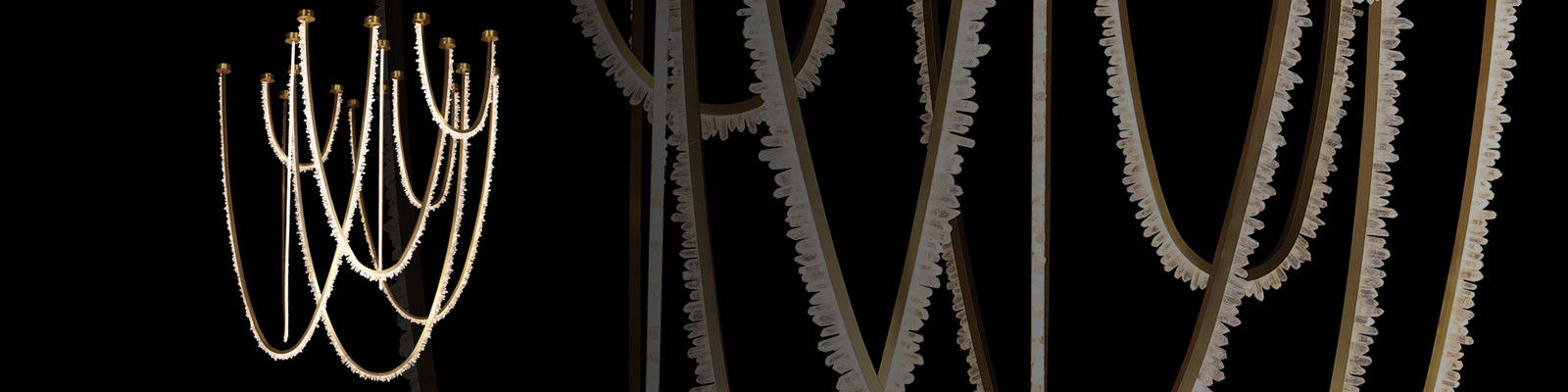
Light possesses physical properties that alter spatial perception. By controlling beam angles, illuminance, and color rendering indices, designers can guide sightlines, demarcate zones, and emphasize material textures. A custom chandelier serves not just as a light source but as a visual anchor, its unique form and light projection injecting dynamic artistic tension into static architectural spaces.
1.2 The Evolution of Aesthetic Value
Many luxury interiors invest heavily in hard surfaces only to compromise their vision with mediocre lighting choices. Custom chandeliers derive their worth from uniqueness—unlike mass-produced alternatives, they achieve architectural harmony, transitioning from mere illumination to curated art installations.
Chapter 2: The Craftsmanship of Custom Glass Chandeliers
Glassblowing stands among humanity's oldest art forms. In contemporary practice, this craft acquires new aesthetic dimensions through modern reinterpretation.
2.1 The Alchemy of Craft and Inspiration
Each glass chandelier begins as molten material. Artisans shape liquid glass through rotational techniques, mold assistance, and precise temperature control—an irreversible process where every bubble distribution and light refraction pattern becomes singular. This "perfection within imperfection" embodies handmade artistry's essence.
2.2 Modern Minimalism Meets Classical Elegance
Designs skillfully merge two aesthetic extremes: modernist purity through geometric functionalism and classical opulence via intricate color layering and organic forms inherited from Murano traditions. This pluralistic language enables fixtures to adapt across spaces ranging from minimalist apartments to European manor houses.
Chapter 3: Bespoke Design—From Spatial Needs to Visual Solutions
Custom lighting fundamentally integrates spatial diagnostics with visual planning, extending beyond dimensional adjustments to interpret a space's inherent character.
3.1 The Designer's Diagnostic Approach
Professional teams begin not with fixtures but with spatial analysis—evaluating ceiling heights, natural light conditions, furnishings, and occupant lifestyles through on-site assessments or blueprint studies. This human-centric methodology ensures lighting integrates organically rather than appearing incongruous.
3.2 Spatial-Light Resonance
Custom chandeliers achieve environmental symbiosis. In high-ceilinged spaces, for instance, precise calculations determine suspension height, proportional scaling, and diffusion patterns to prevent light attenuation or glare, ensuring luminous elegance that enhances spatial stratification.
Chapter 4: Lighting Challenges in Vaulted and Multi-Level Spaces
Double-height areas and stairwells represent interior design's most demanding canvases, where custom chandeliers fully actualize their artistic potential.
4.1 Correcting Visual Imbalance
Standard fixtures often appear disproportionately small or intrusive in expansive volumes. Custom solutions employ vertical extensions or clustered arrangements to elevate sightlines, amplifying spatial grandeur through meticulous weight distribution that establishes proportional harmony.
4.2 The Science of Light Distribution
In stairwells, lighting must satisfy both functional and safety requirements. Strategically tiered custom fixtures ensure even illumination across levels, with refined refraction angles preventing glare while utilizing wall reflections to deepen spatial dimensionality and artistic impact.
Chapter 5: American Craftsmanship in a Global Context
Amid globalization, certain manufacturers exemplify "local production, global collaboration" models that honor regional craftsmanship while integrating worldwide expertise.
5.1 Domestic Production Standards
Complete design and assembly within domestic facilities represents not just quality assurance but a commitment to preserving local manufacturing traditions, ensuring each piece undergoes rigorous performance and aesthetic validation before delivery.
5.2 The Global Artisan Network
While assembled domestically, glass components often synthesize cross-cultural artistry, with international master craftsmen translating diverse aesthetic philosophies into tangible form. This meticulous attention to detail yields pieces that transcend trends, becoming enduring elements of living spaces.
Conclusion: Light as Life's Silent Language
Lighting design's ultimate objective is crafting resonant, uplifting environments. Selecting custom fixtures means embedding narratives within physical spaces.
6.1 From Vision to Reality
Every phase—material selection, iterative design refinement, and final installation—transforms client aspirations into tangible reality. Custom chandeliers function not merely as tools but as emotional modulators and markers of refined living.
6.2 The Longevity of Artistic Companionship
In an era of transience, custom lighting embodies commitment to lasting quality. These pieces resist obsolescence, instead maturing into familial heritage. Each upward glance reaffirms the dignity and serenity conferred by thoughtful customization—illuminating not just spaces but life's boundless possibilities.
Appendix: Professional Guidance for Custom Lighting Selection
- Spatial Proportion Analysis: Before customization, measure ceiling height, floor dimensions, and furniture layouts. Fixture diameters should complement room proportions beyond mere aesthetics.
- Color Temperature Selection: Warm light (2700K-3000K) fosters intimacy, while neutral tones (3500K-4000K) suit modern workspaces. Custom fixtures should enable precise temperature control.
- Material-Light Interaction: Glass, metal, and crystal produce distinct luminous effects. Consider whether diffuse softness or sharp focal points better serve the intended ambiance.
- Maintenance and Safety: High-end customization requires professional installation and aftercare to ensure longevity and operational reliability.


 आपका संदेश 20-3,000 अक्षरों के बीच होना चाहिए!